
The rally in gold prices over the past two years has exceeded even the most optimistic forecasts. What began as a steady upward trend has accelerated into a historic revaluation, leaving many investors reassessing the strategic importance of precious metals in diversified portfolios. As we look toward 2026, the need for a clear understanding of both the opportunities and risks in the space has never been greater.
A Market Rising Far Beyond Expectations
Growing geopolitical tensions, deteriorating global trade relations, swelling U.S. fiscal deficits, and rising concerns about the long-term resilience of the U.S. dollar have driven investors toward gold as a stable and liquid store of value. This surge in demand has pushed the estimated total value of all above-ground gold to more than USD 27 trillion as of September, more than double gold’s “market cap” from just two years earlier.
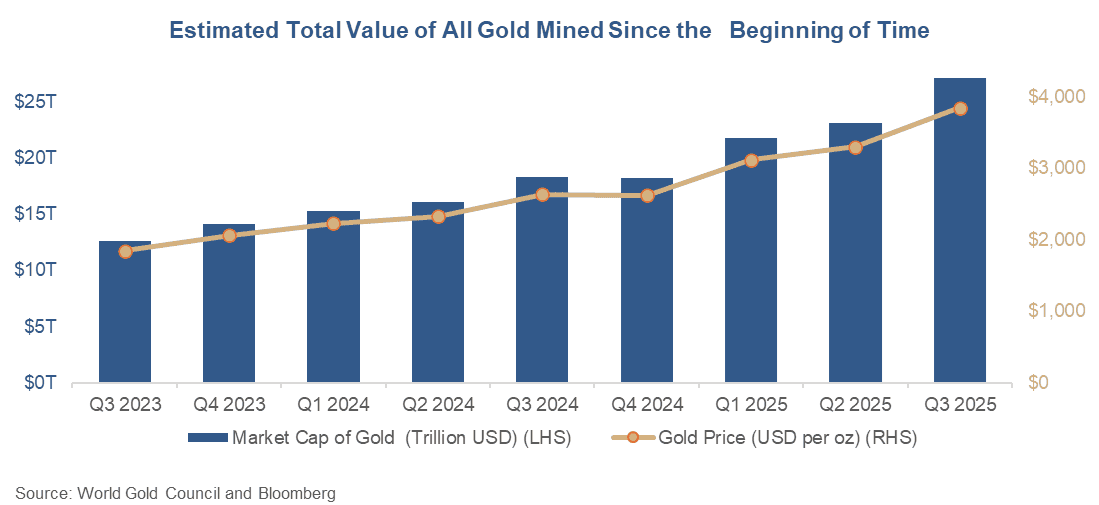
This is not merely a cyclical trend. Structural demand is rising as governments, institutions, and individual investors alike seek assets offering durability, liquidity, and insulation from macroeconomic instability.
Gold’s Expanding Relevance as an Asset Class
Gold has rapidly become one of the world’s fastest-growing asset classes, surpassing broad equity market performance, including that of the Magnificent 7 in recent years. The scale of above-ground gold now eclipses the total value of Bitcoin and is closing in on the size of the U.S. Treasury market, long regarded as the premier global safe-haven asset.
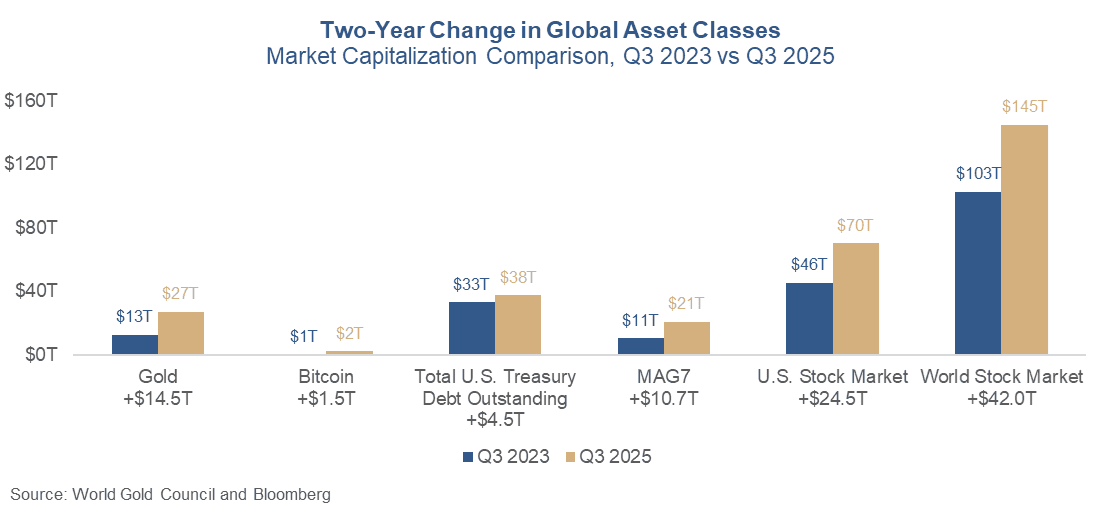
This growing parity reinforces gold’s evolution from a defensive commodity to a strategic, globally held financial asset.
Understanding the Cycles and Cost Pressures
Despite the tailwinds, gold is not without risk. Historically, periods of rapid appreciation have been followed by long consolidations. After gold’s peak in 1980, prices took 28 years to reach new highs; a similar pattern repeated after the 2011 U.S. debt-ceiling-driven peak, with nearly nine years passing before gold advanced to new record levels.
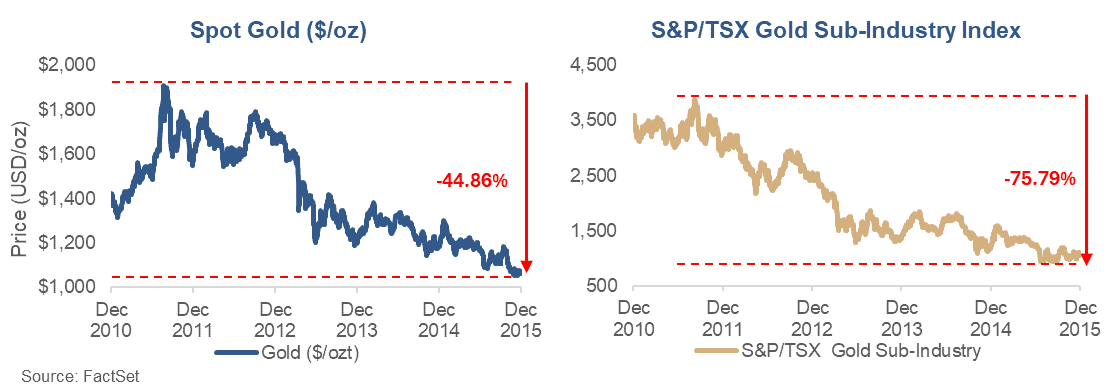
Price consolidation can be severe. From the 2011 high to the late-2015 trough, gold fell almost 45%, and precious metals equities suffered even more dramatically—the S&P/TSX Gold Sub-Index recorded a total return of -75.79%.
Industry-specific risks also cloud the landscape. After years of underinvestment, producers must replace shrinking reserves, but rising demand and competition for engineering services, heavy equipment, and specialized labour is igniting a new wave of capital cost inflation. Cost overruns, delays, and escalating operating expenses can rapidly erode project returns and shareholder value.
High Volatility: A Growing Problem for Portfolio Risk Management
Volatility in the prices of mining equities has increased sharply relative to broader indices. Surging volatility among these companies poses a challenge, especially among institutional investors and their consultants who take portfolio risk management seriously, and for those with policy limits on beta. Equity markets in 2025 have been volatile, with returns disproportionately led by high-beta stocks. In Canada, precious metals equities have led the charge in driving returns for the S&P/TSX Composite Index. For investors, holding higher-beta equities has been the key to generating significant alpha, and in most cases, a requirement for outperforming the Index. However, should the rally falter in 2026, difficult discussions about risk budgets could feature more prominently for investment managers with material allocations to volatile stocks, particularly if these securities underperform.
At the end of November 2025, the weighted-average beta of precious metals equities included in the S&P/TSX Composite Index, on an ex-ante basis, was 2.09, implying these companies are more than twice as volatile as the Index. This is a material departure from the past, when precious metals equities were often less volatile than the overall market.
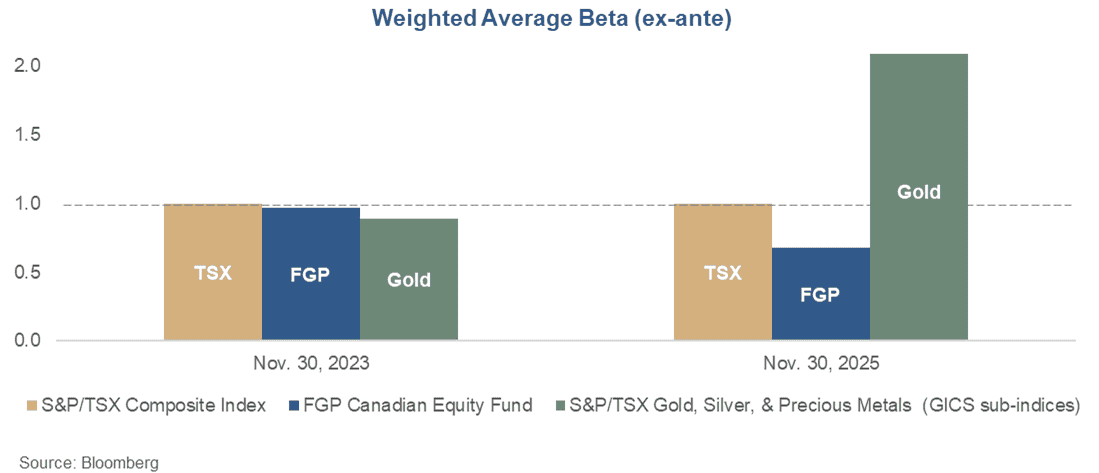
And this situation occurs at a time when the combined weight of precious metals equities totaled 13.8% at the end of November 2025, nearly twice the weight of two years prior.
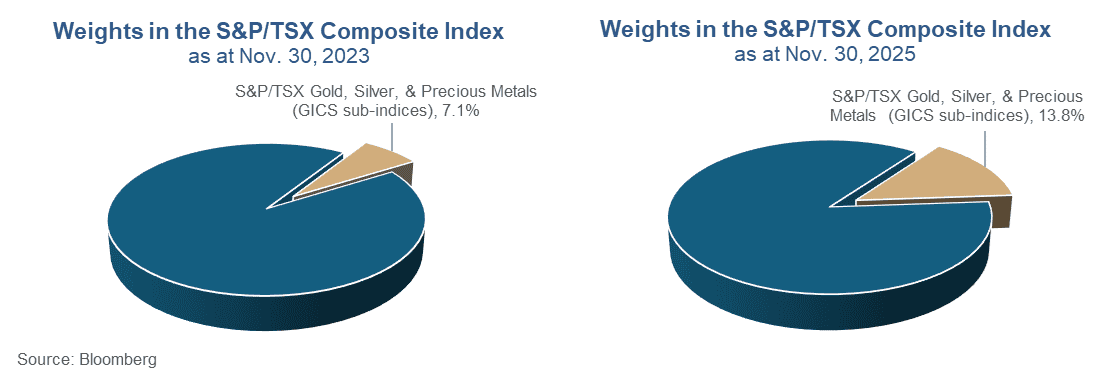 For specialist investors in precious metals equities, high levels of volatility have become table stakes. By comparison, for generalist investors, maintaining a material exposure to precious metals equities has become a high-stakes bet, and suitability considerations should be paramount amid the current backdrop.
Why Gold Companies are not in FGP’s Portfolios
Our principal Canadian equity strategies currently do not have exposure to gold companies, as we have not identified opportunities that meet both our quality and value criteria at prevailing market prices. While there are gold-related businesses with attractive quality characteristics, including strong management and governance, conservative balance sheets, sustainable cash flows, and high returns on capital, valuations across the sector generally offer a limited margin of safety. As a result, our portfolios’ absence from the Gold sub-sector has been a drag on performance this year. We believe current gold company valuations are difficult to justify without assuming gold prices remain elevated for an extended period, which reduces the attractiveness of the sector at this time.
In our view, Canadian equity portfolios are more durable because our performance so far in 2025 has been achieved without any exposure to precious metals companies. Should gold stocks and more broadly or expensively valued companies correct, this positioning is expected to provide our clients with downside protection.
This material is intended for information purposes only and does not constitute legal, tax, securities or investment advice, an opinion regarding the suitability of any investment nor a solicitation of any type. The opinions expressed are as of December 2025 and are subject to change without notice.