
Global equity portfolios have changed dramatically as investors have moved away from regional allocations toward broader, benchmark-driven diversification. Yet this shift has left Canadian equities increasingly underrepresented at a time when resource scarcity, inflation resilience, and regional differentiation are reshaping return opportunities. This paper follows our original piece from February 2023, entitled Inflection Point: The Case for Canada, and examines why Canadian equities continue to deserve a more intentional role as a distinct alpha driver within equity portfolios.
Over the past two decades, institutional equity portfolios have undergone a meaningful transformation. In the aftermath of the Global Financial Crisis, many investors moved away from regionally defined equity allocations towards a more centralized “Global Equity” framework. The rationale was sound: broader diversification and a reduced home-country bias should lower volatility and help achieve higher returns.
However, while global equity allocations delivered many benefits, they also introduced an unintended consequence. By relying on market-cap-weighted global benchmarks, Canadian equities have been reduced to a residual allocation regardless of Canada’s evolving economic relevance or forward-looking return potential.
As the global economy shifts towards regional differentiation, we believe it is an appropriate time to revisit the role of Canadian equities as a deliberate alpha driver within a global equity allocation rather than as a legacy home-country bias exposure.
Global Diversification Does Not Require Regional Indifference
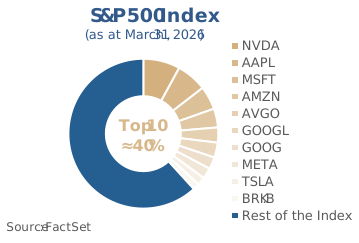
The move to global equity benchmarks implicitly assumes that country weights are neutral and efficient. Yet global benchmarks are backward-looking by construction, reflecting past market capitalizations rather than future economic opportunity. As a result, they tend to concentrate capital in regions and sectors that have already experienced extended periods of outperformance.
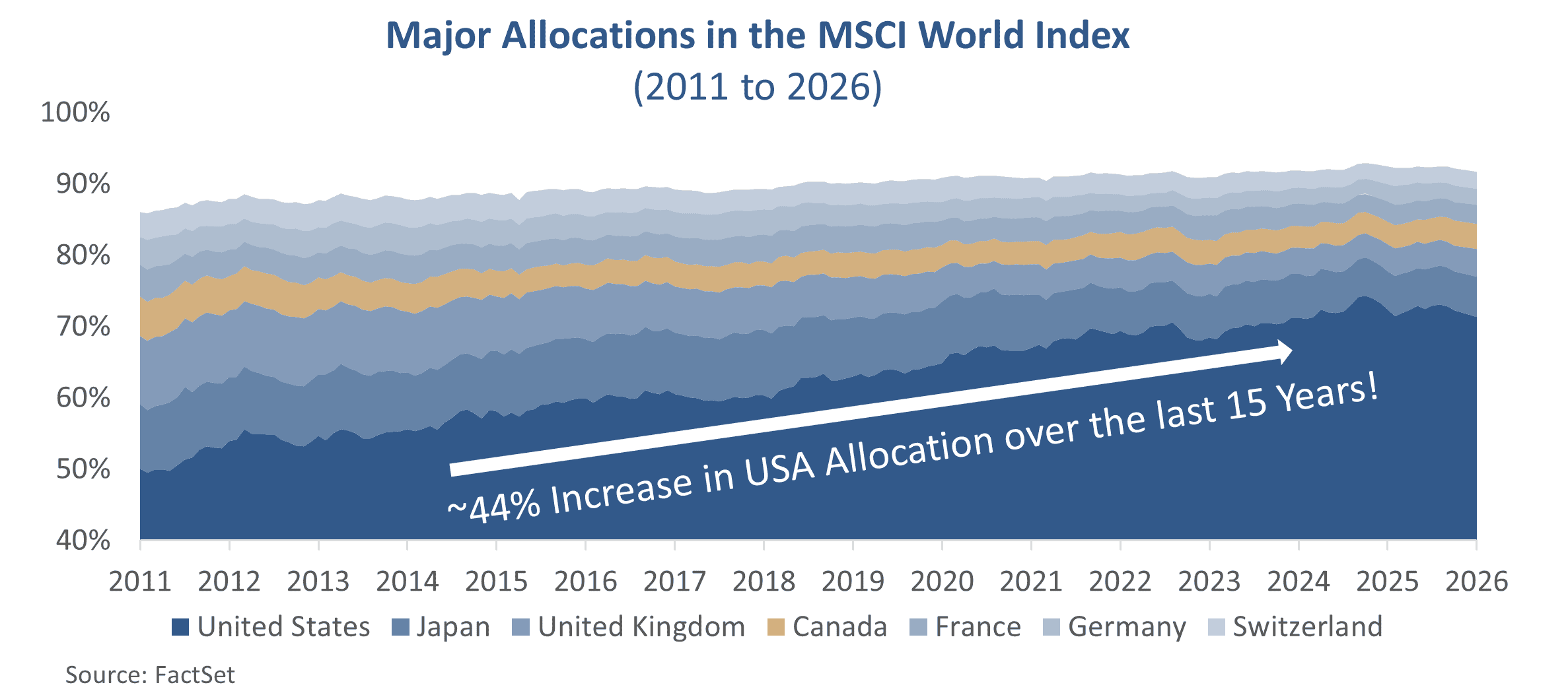
Today, the MSCI World Index is heavily influenced by a narrow group of U.S.-dominated mega-cap growth companies.
While these businesses are undeniably high quality, this concentration increases sensitivity to interest rates, valuation risk, and shifts in the growth-inflation regime. At the same time, it materially reduces exposure to markets that are more closely linked to fundamentals, characteristics that have historically proven valuable during periods of macroeconomic transition.
Canada is one such market.
Canada’s Differentiated Economic Exposure
The Canadian equity market provides a markedly different set of return drivers than the broader MSCI World Index. With meaningful exposure to energy, materials, financials, and industrials, Canada is more closely aligned with themes that are increasingly shaping the global economy: resource scarcity, energy security, infrastructure investment, and inflation resilience.
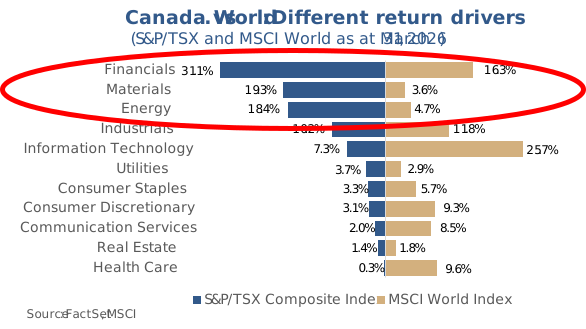
As we outlined in our 2023 Foyston For Thought, Inflection Point: The Case for Canada, global trends around de-globalization, higher interest rates, and constrained commodities are reshaping the investment landscape. These forces favour regions with abundant natural resources, stable institutions, and the capacity to supply critical inputs to the global economy. Canada is uniquely positioned on all fronts. Recent geopolitical developments, particularly the conflict involving Iran, have brought into sharper focus the structural shifts we outlined in our 2023 thought piece. What were once emerging trends, de-globalization, higher-for-longer interest rates, and constrained commodities, are now being tested and validated in real time. These dynamics continue to favour regions with resource depth, institutional stability, and global relevance in critical supply chains, areas where Canada stands out. This exposure is not easily replicated within a standard global equity benchmark. In many cases, investors must step outside the benchmark to gain meaningful access to these themes.
Structural Under-Allocation Creates Opportunity
The reduced weight of Canada within global benchmarks is not a reflection of diminished opportunity, but rather a byproduct of market-cap mechanics and past performance cycles. This creates an opportunity for active investors.
Canadian equity markets remain relatively under-researched compared to larger global peers, particularly outside the largest index constituents. This inefficiency creates fertile ground for active management, where fundamental research, security selection, and valuation discipline can add value.
Rather than viewing Canadian equities as a passive exposure embedded within a global benchmark, we believe they are better positioned as a distinct allocation where active management can exploit mispricing, manage cyclicality, and deliver differentiated returns.
A Real-Time Case Study
The relevance of Canadian equities as an alpha source is not merely theoretical. It has been evident in recent performance.
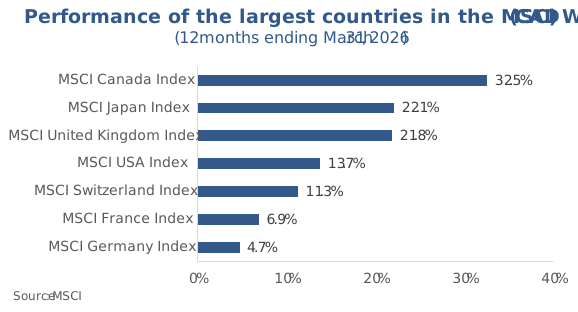
In our view, the performance dispersion shown above is not an isolated outcome but rather a reminder that regional return leadership can shift meaningfully over time.
Canadian Equities as an Alpha Sleeve
We believe the most effective way to incorporate Canadian equities within a global equity portfolio is not through passive benchmark exposure but through a dedicated, actively managed allocation.
By structuring portfolios as Global Equity ex-Canada plus a distinct Canadian equity allocation, investors can achieve the following objectives:
- Maintaining global diversification
- Avoiding unintended benchmark-driven underweights
- Allocating capital intentionally to a market with differentiated return drivers
- Holding active managers accountable for alpha generation
This approach reframes Canadian equities from a residual allocation to a purposeful source of return.
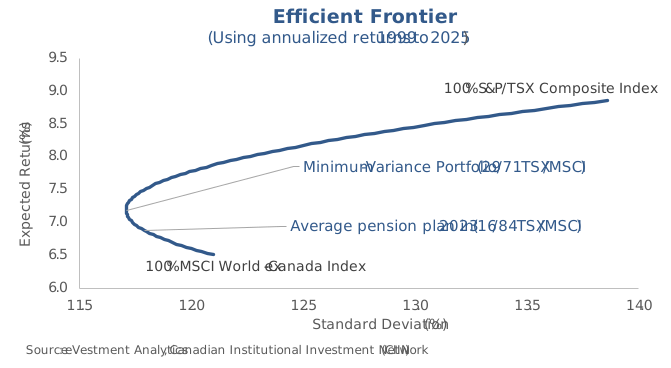
According to our analysis using data sourced from eVestment Analytics and the Canadian Institutional Investment Network (CIIN), the average Canadian pension fund needs to increase its allocation to Canadian equities to reach the minimum variance point on the efficient frontier.
Implications for Portfolio Construction
We believe investors should consider a more thoughtful approach to global equity construction, keeping in mind macro dispersion, inflation, and regional differentiation. In the current environment, relying solely on a single global benchmark may obscure opportunities that exist at the regional level.
Canadian equities offer a complementary exposure to global portfolios—one that is aligned with current economic realities and positioned to benefit from long-term structural trends. When combined with active management, this allocation has the potential to enhance returns while improving overall portfolio balance.
Conclusion
Canada’s diminished presence in global equity benchmarks has less to do with its future prospects and more to do with the mechanics of index construction. As global conditions evolve, we believe investors should reassess whether benchmark country weights remain an appropriate guide for capital allocation.
Canadian equities should not be viewed as a legacy home-country bias allocation. Investors should instead view the Canadian stock market as a deliberate alpha driver within their global equity portfolios, particularly in a world where economic regimes are shifting, resources are constrained, and regional differentiation has returned.
In our view, the question is no longer whether Canada belongs in a global equity allocation, but whether investors can afford to ignore it.
This material is intended for information purposes only and does not constitute legal, tax, securities or investment advice, an opinion regarding the suitability of any investment nor a solicitation of any type. The opinions expressed are as of March 2026 and are subject to change without notice.